Imagine this scenario: It's 11:47 PM on a Tuesday. A high-intent prospect lands on your website. They are ready to purchase your premium service or hire your company for an urgent project. But before they click the "Buy" or "Book" button, they have one critical question about your delivery terms or contract options.
They look at the bottom-right corner of their screen and click the chat icon. They type their question.
Now, who should be on the other end to help them?
- A Human Chat Agent who is either asleep, multitasking, or costing your business a premium hourly rate to work the night shift?
- A Traditional Chatbot that displays a rigid, frustrating menu of pre-written buttons and fails to understand any custom query?
- An AI Chatbot that instantly reads their question, references your entire knowledge base, qualifies them as a high-intent lead, and schedules a meeting on your sales calendar in under five seconds?
For modern businesses, website chat is no longer an optional luxury. It is the primary channel for lead generation, customer support, and conversion rate optimization. However, selecting the wrong chat infrastructure can either drain your monthly budget or drive high-value prospects straight into the arms of your competitors.
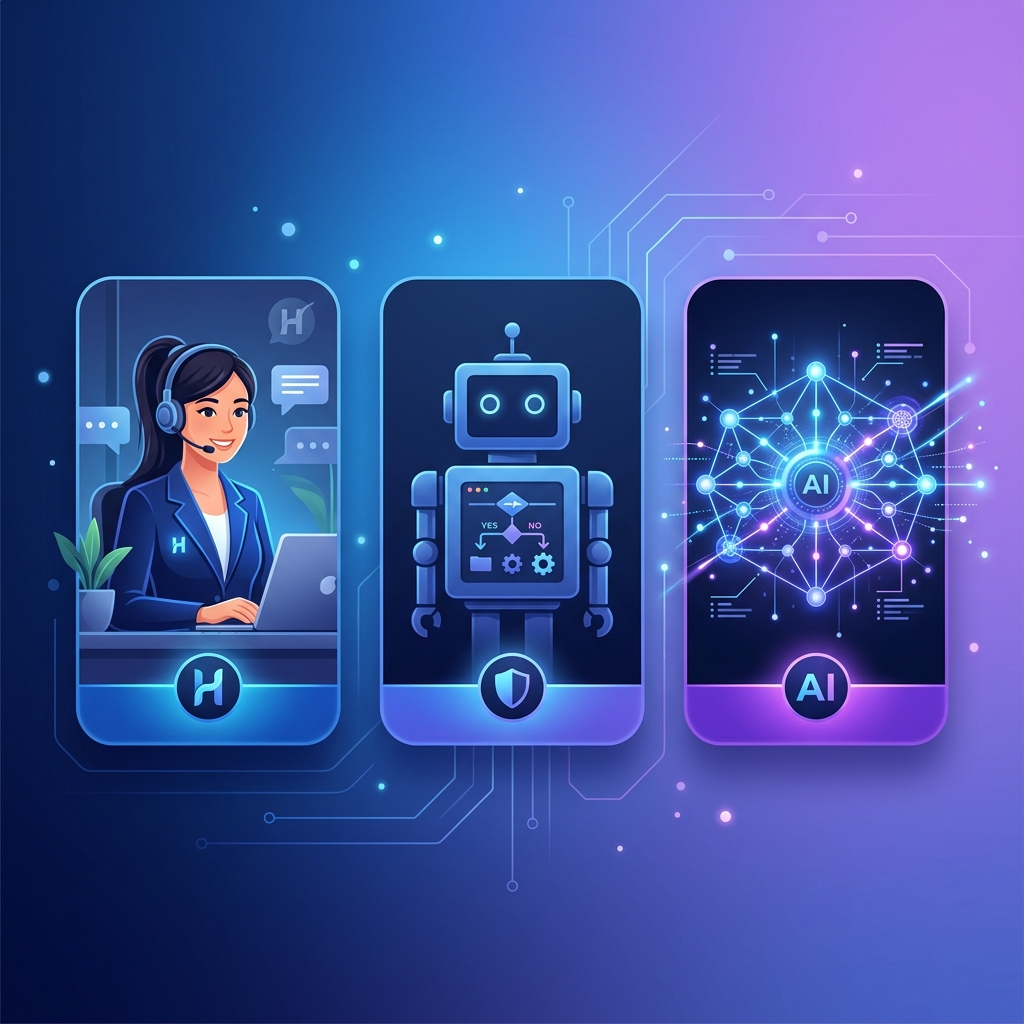
In this comprehensive guide, we will break down the differences, pros, cons, costs, and best use cases for Human Chat Agents, Traditional Chatbots, and AI Chatbots to help you make an informed decision for your business.
- Human Chat Agents offer the highest empathy and can handle complex, customized negotiations, but they do not scale, are expensive, and are rarely active 24/7.
- Traditional Chatbots (rule-based) are cheap and highly structured, but they create user frustration when visitors type natural language queries that fall outside the pre-programmed decision trees.
- AI Chatbots combine the 24/7 speed and low cost of automation with the natural language flexibility of human conversation, making them the most cost-effective tool for lead qualification, instant FAQs, and appointment booking.
- Hybrid Models—where an AI chatbot handles 80% of common queries and qualifies leads, then hands off the conversation to a human agent for complex closes—are becoming the industry standard.
What Is a Human Chat Agent?
A Human Chat Agent is a live person employed by a company (or contracted through an agency) to sit in front of a live chat dashboard and respond manually to incoming website inquiries.
These agents may be in-house employees, remote customer service specialists, or outsourced live chat operators working from call centers globally.
How It Works
When a visitor initiates a chat on the website, a notification ping alert is sent to the human agent's software (such as LiveChat, Intercom, or Zendesk). The agent claims the chat, reviews the user's message, and manually types a reply. If no agent is online, the chat widget either displays an "Offline" message, prompts the user to leave an email, or queuing system puts the visitor on hold.
The Advantages of Human Chat Agents
- High Emotional Intelligence & Empathy: Humans excel at understanding nuance, frustration, sarcasm, and complex customer emotional states. When a customer is upset about a billing error, a human agent can calm them down in a way no machine can replicate.
- Flexible Problem Solving: Human agents can navigate multiple systems, think outside the box, make custom exceptions, and handle highly complex, multi-layered inquiries that require creative problem-solving.
- Advanced Closing Power: For high-ticket B2B sales or complex consultations, a skilled human agent can negotiate prices, address highly specific objections, and close deals directly inside the chat window.
The Disadvantages of Human Chat Agents
- Prohibitive Costs: Employing in-house agents or hiring 24/7 outsourced live chat agencies is extremely expensive, costing thousands of dollars per month in salaries, benefits, and software licenses.
- Limited Scalability: A single human agent can comfortably handle only 2 to 3 chat sessions simultaneously before response quality and speed drop significantly. During traffic spikes, customers face long wait times.
- Slow Response Times: Even when online, human response times average between 45 seconds to 2 minutes, which is an eternity in the age of instant digital satisfaction.
- Human Error & Availability: Humans get tired, make typographical errors, require breaks, and cannot work 24/7/365 without complex shift planning and high overnight premiums.
Typical Costs
- In-House US/Europe Agent: $3,000 to $4,500+ per month per agent.
- Outsourced Chat Agency (Global): $150 to $800+ per month per seat (often with volume limits or limited operational hours).
- Software Licensing: $20 to $100+ per seat/month for live chat platforms.
Best Use Cases
- High-ticket B2B sales environments where average deal values exceed $10,000.
- Complex legal, medical, or financial consults requiring strict compliance and customized professional advice.
- Escalated enterprise support desks handling critical software bugs or custom database issues.
What Is a Traditional Chatbot?
A Traditional Chatbot (often called a rule-based, decision-tree, or script-based chatbot) is a pre-programmed software application that follows a rigid flowchart. It guides visitors through a set sequence of options, usually presented as clickable buttons.
How It Works
Traditional chatbots do not "understand" what a user is typing. Instead, they rely on pre-programmed decision trees. For example, the bot asks: "Are you interested in pricing or services?", and the user must click the "Pricing" button. The bot then displays button options for plans. If the user types a free-form question like "Can I pay with PayPal?", the bot fails to understand and repeats its button options or says, "I didn't get that. Please select one of the options below."
Some traditional chatbots use basic keyword matching. If the user's input contains the exact word "refund", the bot serves the refund policy link. However, if the user types "I want my money back", the bot fails because the word "refund" was not detected.
The Advantages of Traditional Chatbots
- Low Cost: Once built, traditional chatbots cost almost nothing to run. There are no expensive API costs or complex neural network computations.
- Controlled, Predictable Flows: Since the bot only outputs pre-written text and button paths, there is zero risk of the chatbot "hallucinating" (making up incorrect information) or going off-script.
- Good for Simple Data Collection: They are highly efficient at collecting simple, standardized information, such as asking for a visitor's name, email, and company size before transferring them to a form.
The Disadvantages of Traditional Chatbots
- Severe Conversational Frustration: Customers dislike being forced into rigid button paths. If their specific question isn't listed as a button, the bot becomes a barrier rather than a helper.
- Zero Contextual Awareness: If a user makes a typo or phrases their question in an unusual way, the bot breaks down, leading to the dreaded endless loop of "Sorry, I didn't understand that."
- High Maintenance Overhead: As your business products, pricing, or details change, you must manually rebuild the complex flowchart nodes, which can quickly become a mapping nightmare.
Typical Costs
- Basic Builders: $15 to $50 per month.
- Enterprise Builders: $150 to $500 per month.
- Setup Costs: Often requires hours of manual drag-and-drop flowchart configuration.
Best Use Cases
- Simple customer intake forms (e.g., gathering contact details for support ticket creation).
- Basic routing menus (e.g., "Press 1 for Sales, Press 2 for Support").
- Static websites with highly limited, unchanging service options.
What Is an AI Chatbot?
An AI Chatbot (or conversational AI assistant) represents the modern generation of website communication. Powered by Natural Language Processing (NLP) and Large Language Models (LLMs), these chatbots understand human language, maintain context over a conversation, and dynamically retrieve answers from a custom business database or knowledge base.
How It Works
Unlike rule-based systems, an AI chatbot behaves like a knowledgeable virtual employee. You train the AI by uploading your website URLs, PDFs, business catalogs, help center articles, or FAQs.
When a user types a question in plain English (or any other language)—for example: "Hey, do you guys do emergency plumbing on Sundays in North London?"—the AI analyzes the user's intent, searches its custom knowledge base, and writes a natural, instant reply: "Yes, we do! We have 24/7 emergency plumbers stationed in North London on Sundays. Would you like me to book a technician for you right now?"
Furthermore, modern AI chatbots (like SIVACE) are built to proactively qualify website leads, capture email addresses, and integrate directly with calendar systems (like Google Calendar or Calendly) to schedule appointments.
The Advantages of AI Chatbots
- Instant, 24/7/365 Responsiveness: AI replies in milliseconds, at any time of day or night. There are no queues, hold times, or offline hours.
- Natural Conversational Abilities: Visitors can type naturally, make spelling mistakes, use slang, or ask follow-up questions, and the AI will understand the context and maintain a fluid conversation.
- Automated Lead Qualification & Booking: AI assistants don't just answer questions; they guide visitors toward business goals. They can ask qualifying questions (e.g., "What is your budget?"), collect contact details, and book meetings directly into your sales calendar.
- Multilingual Support: Modern AI chatbots can instantly translate and converse in over 50+ languages, enabling you to expand your business globally without hiring multilingual staff.
- No Hallucinations (Knowledge Grounding): Advanced business AI bots use Retrieval-Augmented Generation (RAG). They are strictly locked to your uploaded documents, ensuring they only answer questions using your verified business details.
The Disadvantages of AI Chatbots
- Lack of Human Empathy: While conversational, AI doesn't feel genuine emotion. If a customer is grieving or experiencing an extreme crisis, the AI cannot offer authentic human sympathy.
- Requires Initial Knowledge Setup: To be effective, you must provide the AI with clean, accurate business documentation. If your uploaded files contain outdated pricing, the AI will quote the outdated pricing.
Typical Costs
- SaaS AI Chatbot Platforms: $29 to $299 per month (scaling based on usage and advanced integrations).
- Setup Costs: Minimal. Modern platforms allow you to copy-paste your website URL to train the bot in under 5 minutes.
Best Use Cases
- Local Service Businesses: Contractors, plumbers, law firms, and dentists looking to capture leads and book appointments 24/7/365 without paying overnight staff.
- SaaS and E-Commerce Startups: Handling high-volume FAQs, guiding users to product pages, and qualifying sales leads.
- Any business that receives repetitive customer questions and wants to free up human staff from answering the same 20 queries daily.
Detailed Comparison Table
Let's look at a head-to-head comparison of all three technologies across key business metrics:
| Metric | Human Chat Agent | Traditional Chatbot | AI Chatbot (e.g. SIVACE) |
|---|---|---|---|
| Availability | Limited (business hours) | 24/7/365 | 24/7/365 |
| Response Speed | 45 sec – 2 min | Instant | Instant |
| Scalability | Low (max 3 chats) | Unlimited | Unlimited |
| Conversational Flexibility | Maximum | None (buttons only) | High (context + intent) |
| Lead Generation | High (agent skill) | Low (form-like) | Maximum (interactive) |
| Appointment Booking | Manual | Rigid links | Dynamic in-chat |
| Maintenance Effort | High | High | Low |
| Language Translation | None | Hardcoded | Auto (50+ languages) |
| Monthly Cost | $1,500 – $5,000+ | $15 – $100 | $29 – $299 |
| Human Empathy | Maximum | Zero | Simulated / Task-focused |
Real Business Examples
To see how these differences play out, let's explore how different business niches benefit from each option:
Example 1: Local Plumbing Company
- The Challenge: Plumbers get most emergency calls in the evenings and weekends when their office staff is offline.
- Human Agent: Hiring an agency for night-shift support costs $1,200/month.
- Traditional Bot: A rule-based bot displays buttons: "Book" or "Hotline". If the customer types, "My water heater is leaking right now, how fast can you get here?", the bot repeats: "Please select an option." The user exits, frustrated.
- AI Chatbot (Winner): The AI reads the water heater query, checks the custom knowledge base, answers: "We have emergency technicians available within 45 minutes. What is your address?" The AI captures the details, registers the lead, and alerts the manager.
Example 2: Law Firm
- The Challenge: Law firms receive hundreds of leads, but only a small fraction are qualified cases. Attorneys charge high hourly rates and cannot waste time on basic consultations.
- Traditional Bot: Asks: "Is this about a divorce, injury, or contract?" Very dry and form-like.
- Human Agent: Live chat agents must be highly trained to avoid giving unauthorized legal advice, creating liability risks.
- AI Chatbot (Winner): The AI is strictly trained on the firm's intake guidelines. It converses politely, qualifies the user (e.g., "Did this accident happen within the last 2 years?"), and schedules a consultation only if the case meets the firm's criteria.
Example 3: E-Commerce Store
- The Challenge: E-commerce stores get flooded with repetitive tickets: "Where is my order?", "What is your return policy?", and "Do you ship to Canada?"
- Human Agent: Paying support reps to answer these same 3 questions all day is a massive waste of resources.
- AI Chatbot & Human Hybrid (Winner): An AI Chatbot is connected to the store's knowledge base. It instantly answers 85% of common shipping/return questions. If a customer has a complex billing issue, the AI automatically passes the ticket to a human agent.
Example 4: Digital Marketing Agency
- The Challenge: Agencies sell custom services ranging from $2,000 to $10,000/month. Prospects require detailed proposals and custom strategies.
- AI Chatbot: Can answer general FAQs about the agency's case studies and services, collect email/website links, and book a discovery call.
- Human Agent (Winner): For high-ticket consulting, once the prospect is warmed up, a human strategist needs to jump into the chat to negotiate scope and close the retainer.
Cost Comparison
Let's look at the financial implications of each model. We compare the typical costs of running these systems for a growing website receiving approximately 5,000 visits per month.
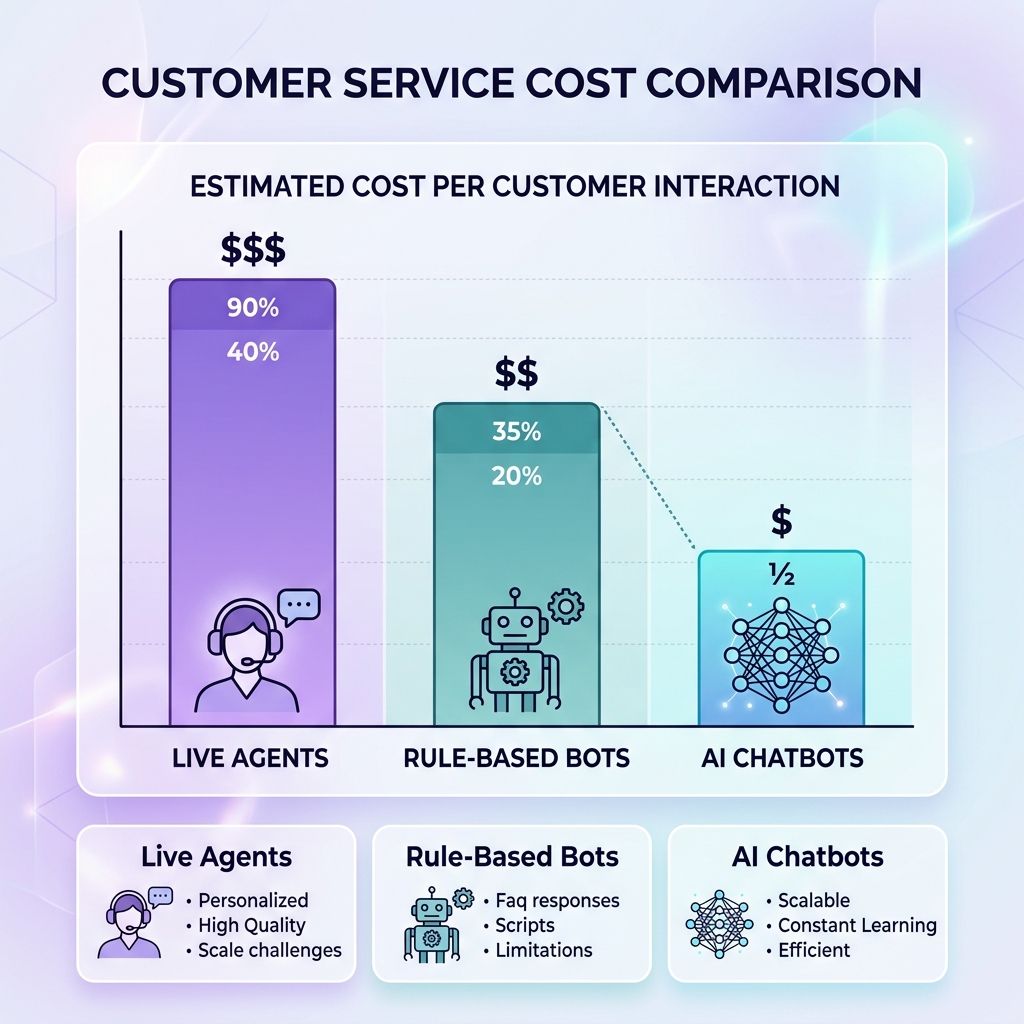
| Cost Category | Human Agent (24/7) | Traditional Chatbot | SIVACE AI Chatbot |
|---|---|---|---|
| Setup & Build | $0 (agency) | $500 – $2,500 | $0 (No-code) |
| Monthly Software | $150 | $30 – $80 | $99 (Pro Plan) |
| Monthly Labor | $2,400 | $0 | $0 |
| API/Query Costs | $0 | $0 | $0 (flat plan) |
| Yearly Total | $30,600 | $1,460 | $1,188 |
ROI Considerations
- Human Agents cost an average of $5.00 to $15.00 per conversation. If you get 500 chats a month, that's $2,500 to $7,500.
- Traditional Chatbots have low monthly software costs, but their low conversion rates mean you lose potential customers. If a user gets frustrated and leaves, the cost is the lost lifetime value of that customer.
- AI Chatbots cost an average of $0.10 to $0.30 per conversation. Because they are active 24/7, respond instantly, and book meetings, they typically pay for themselves within the first 1 to 2 captured leads.
Can AI Replace Human Agents?
The short answer is: No, but AI will replace businesses that rely only on human agents.
A balanced perspective reveals that AI and humans have entirely different strengths:
What AI Chatbots Do Exceptionally Well
- Extreme Speed: AI does not make customers wait. It responds in milliseconds.
- Infinite Patience: AI never gets tired, stressed, or rude, even when dealing with aggressive customers at 3:00 AM.
- Scale: AI can handle 10,000 customers at the exact same second without breaking a sweat.
- Data Processing: AI can scan a 200-page product manual instantly to find a specific compatibility detail.
What Humans Do Exceptionally Well
- Complex Negotiations: Closing high-ticket contracts that require custom deals, relationship building, and deep trust.
- True Empathy: Comforting a customer who has experienced a loss or a frustrating system outage.
- Out-of-the-Box Resolution: Handling unique situations that have never occurred before and aren't documented in any manual.
The Rise of the Hybrid Model
The most successful modern businesses utilize a hybrid model.
- The AI Chatbot sits on the front lines. It handles the initial greeting, answers FAQs, collects lead data, and qualifies visitors.
- If the visitor asks a highly technical question, requests a custom discount, or expresses extreme frustration, the AI triggers a Human Handoff.
- A human agent receives a desktop notification, reviews the AI's chat history, and seamlessly takes over the conversation.
This hybrid approach reduces support volume by 75% to 80%, allowing your team to focus their energy on high-value client closing and complex problem-solving.
The Future of Website Conversations
We are moving away from static websites containing complex navigation menus and dry contact forms. The websites of the future are conversational.
1. The Demise of the Traditional Lead Form
Fewer people want to fill out a form with 10 fields and wait "24 to 48 business hours" for a response. Customers expect to open a chat, ask a question, get qualified, and book a call immediately. AI makes this possible in a single session.
2. Conversational Search
Instead of browsing search boxes or trying to find a specific PDF link on your site, users will simply ask your website's AI assistant: "Can you show me the paragraph in your terms of service regarding data protection?" The AI will locate the details and summarize it instantly.
3. Hyper-Personalized Lead Nurturing
Future AI chatbots will sync with your customer relationship management (CRM) systems. When a returning lead lands on your page, the AI will remember their name, know their open deals, and tailor the conversation: "Hi Mark, welcome back. Are you still looking to launch your SEO campaign this month?"
Conclusion: Which Solution Should You Choose?
Selecting the right option depends on your business stage, budget, and operational goals:
Choose Human Chat Agents if:
- You sell highly customized, high-ticket products (e.g., enterprise software, luxury real estate, custom medical procedures) where human relationship building is mandatory.
- Your monthly chat volume is low, and your team is already online during business hours to handle incoming chats.
Choose Traditional Chatbots if:
- You only need to build a basic contact information capture screen or a simple navigation menu.
- Your website visitors do not ask complex, varied questions, and you have the time to manually maintain drag-and-drop flowchart trees.
Choose AI Chatbots (SIVACE) if:
- You are a small business, service business, or contractor looking to capture leads and book appointments 24/7/365 without paying overnight staff.
- You want to reduce repetitive support ticket volumes and free up your staff.
- You want a setup that trains itself in minutes using your existing website URLs and documentation.
In 2026, visitors do not wait. By deploying a modern conversational AI assistant like SIVACE, you ensure your business is always open, always fast, and always ready to turn a casual click into a customer.